
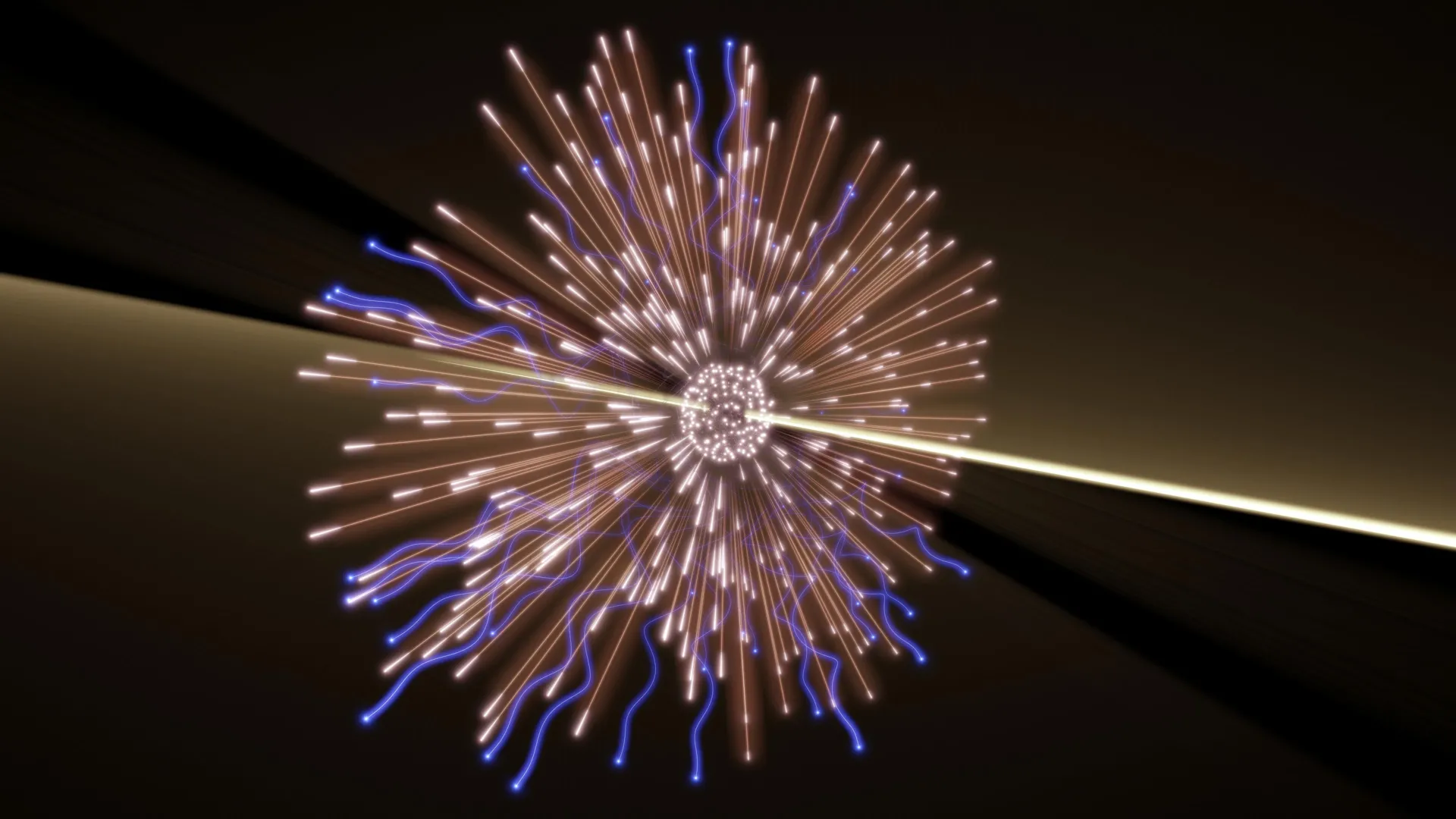

Higgs decays at ATLAS show 4.7-sigma evidence that pairs of massive, short-lived Z bosons share a single quantum state.
Einstein called it “spooky action at a distance.” For a century, physicists have shown that two particles can share a single quantum state, so that measuring one instantly constrains the other. The tests usually involve photons or cold atoms in a quiet lab. This month the ATLAS collaboration at CERN reported that the same effect survives in some of the heaviest, shortest-lived particles the Standard Model allows.Link.aps
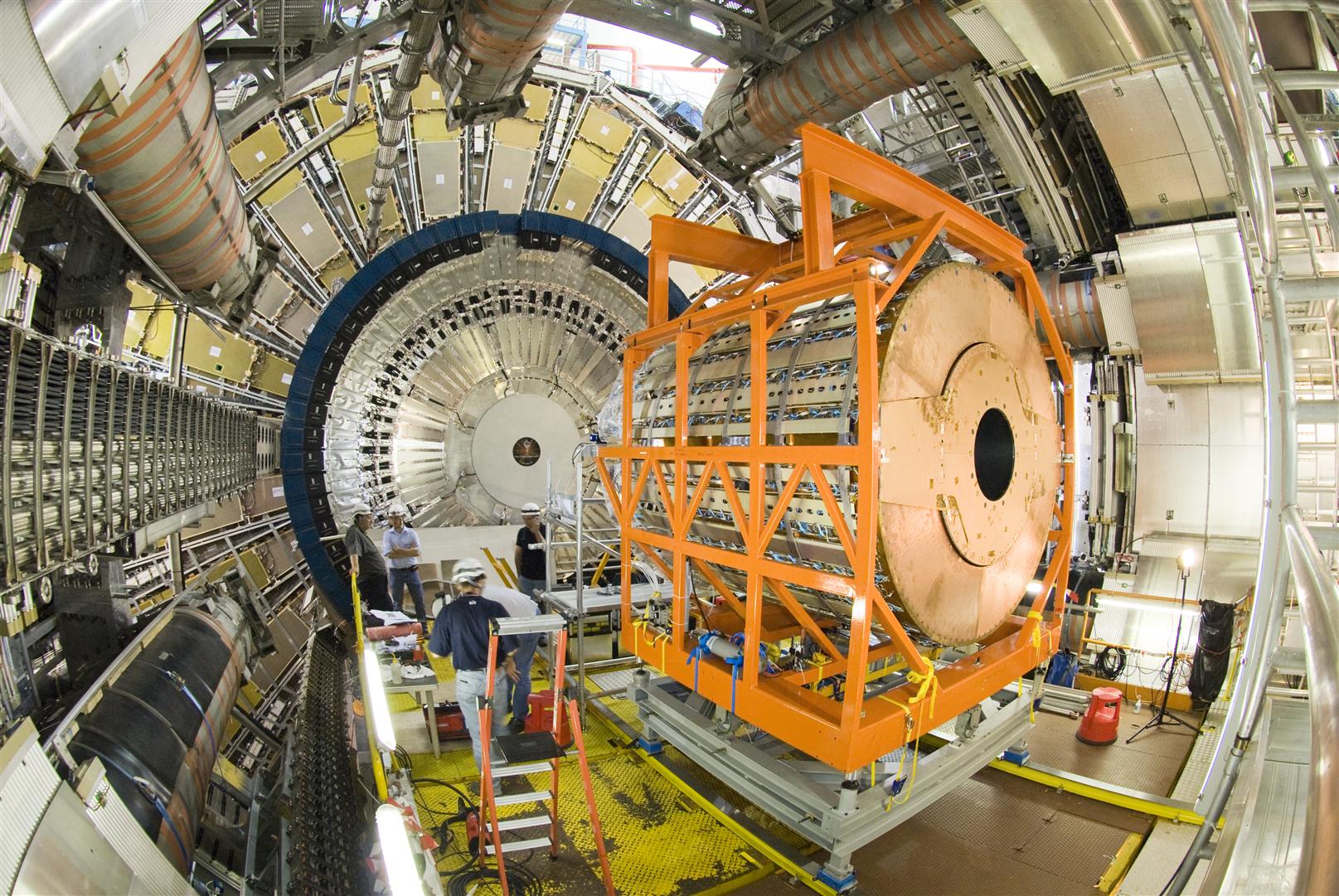
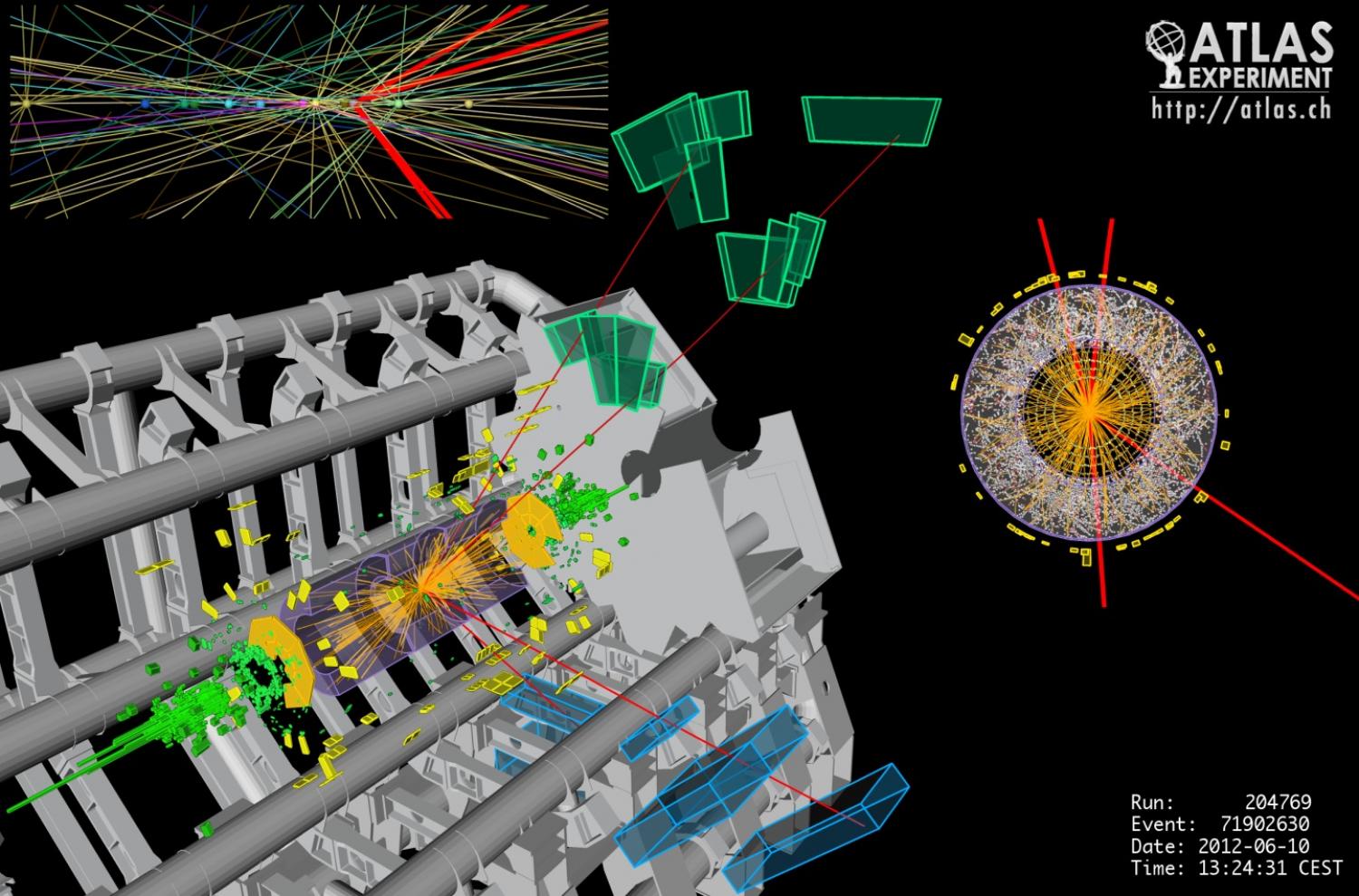
The result, published 11 September in Physical Review Letters, is the first strong evidence of spin entanglement between a pair of Z bosons. Those bosons are produced when a Higgs boson decays. Each Z lives about 3×10⁻²⁵ seconds before it falls apart into electrons or muons. That is far too brief for any detector to watch the Z itself. ATLAS instead reconstructed the angles of the four leptons left behind and used those angles to infer the original spins.Ox
The data favor an entangled state over a separable one at 4.7 standard deviations, just short of the conventional five-sigma discovery line. The expected significance was 4.9 sigma. Researchers describe the finding as “strong evidence,” not a formal observation. Even so, it extends quantum entanglement into a new regime: massive spin-1 particles, or qutrits, at electroweak energies.
Why a Higgs decay is the right laboratory
A Higgs boson has spin zero. When it decays to two Z bosons, the pair must conserve that total spin. The two Zs therefore cannot occupy any combination of polarizations they like. Their three possible spin projections (+1, 0, −1) must cancel. That constraint forces the pair into a highly correlated state. Theorists had predicted the correlation would be even stronger than the entanglement already seen in top-quark pairs in 2023–24.Sciencealert
Juan Antonio Aguilar-Saavedra of Spain’s Institute of Theoretical Physics, who helped build the theoretical toolkit, put it simply: the two Z spins are “extremely entangled, considerably more so than in the top-antitop case.” Because a Z boson has three spin states rather than two, it is a qutrit rather than a qubit. This is the first time entanglement has been measured between elementary particles that are qutrits.Sciencealert
One of the two Zs in each decay is off the mass shell—a “virtual” particle. The measurement treats the real and virtual bosons as a single joint system. Non-zero values of the off-diagonal spin-density-matrix coefficients C2,1,2,−1 and C2,2,2,−2 are the signature that the two cannot be described independently. ATLAS measured C2,1,2,−1=−0.71±0.45 and C2,2,2,−2=0.08±0.44, consistent with Standard Model expectations. A likelihood-ratio test using the full angular distribution then rejected the non-entangled hypothesis at 4.7 sigma.arXiv
The analysis combined the full LHC Run 2 sample at 13 TeV with three years of Run 3 data at 13.6 TeV. Even after years of collisions, only a few hundred clean four-lepton events survived the selection. Statistics, not systematics, still dominate the uncertainty.
What the measurement actually tests
The experiment does not yet constitute a full Bell test. Distinguishing which lepton pair came from which Z is ambiguous, and the analysis relies on several Standard Model assumptions about the decays. The team therefore frames the result as a test of quantum non-separability rather than a loophole-free violation of local realism. That is still a substantial step. Previous collider entanglement results involved fermions (top quarks). Vector bosons open a different chapter of quantum information at the TeV scale.
Professor Alan Barr of the University of Oxford, an early advocate of using colliders as quantum laboratories, said the finding shows how robust the effect is. “We’re used to thinking of entanglement as something delicate, seen in laboratory experiments with single photons. Finding it alive and well among particles as heavy and short-lived as Z bosons… shows just how fundamental and robust this quantum effect really is.” Barr was among the first to argue that the LHC could probe quantum mechanics at energies a trillion times higher than tabletop tests, and over distances smaller than a nucleus.
If entanglement failed here, the consequences would be profound. Quantum field theory assumes the same rules apply at every scale. A breakdown at the electroweak scale would force a rewrite of the foundations. So far the rules hold.
Why this matters beyond particle physics
The same correlations that appear in Higgs decays are the resource that quantum computers and quantum networks try to engineer and protect. Seeing them persist in a violent, high-energy environment is both a consistency check and a new diagnostic. Future High-Luminosity LHC data, plus the ATLAS detector upgrade now under construction, will shrink the statistical errors. Other decay channels and direct ZZ production can then be examined with the same quantum-information toolkit.
For now the message is simpler. The strangest feature of quantum mechanics is not confined to quiet optics benches. It is written into the decay of the Higgs boson itself.
AI Disclosure: This article was created with the assistance of artificial intelligence tools and was reviewed and edited by the Glowls News editorial team before publication.