
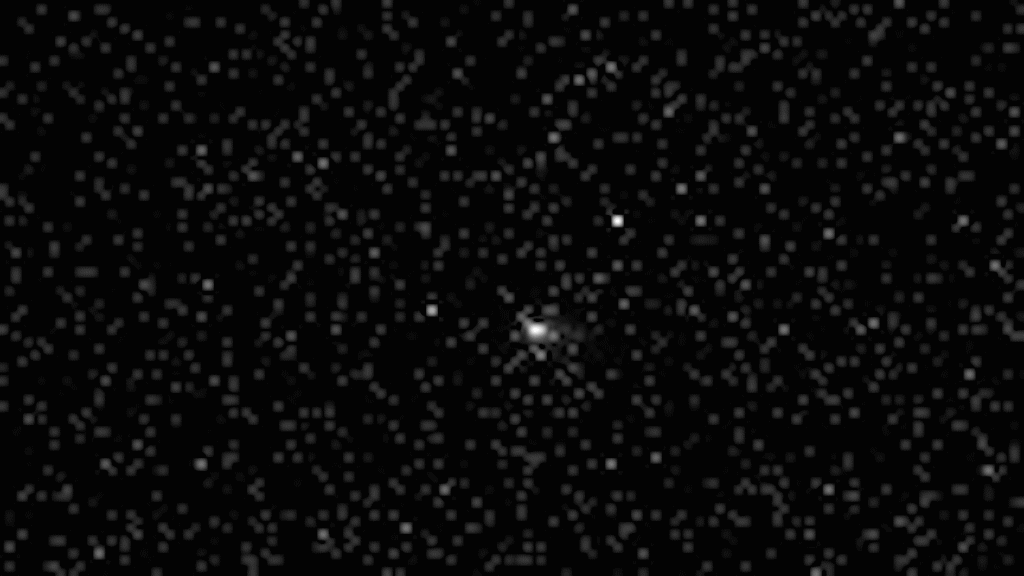

Tianwen-1’s camera locked onto the third known interstellar visitor as it raced past Mars, delivering a hard-won view of material forged around another star.
In early October 2025, a faint, fast-moving speck of light crossed the Martian sky. China’s Tianwen-1 orbiter, already more than four years into its mission around the Red Planet, turned its High-Resolution Imaging Camera toward the object and succeeded where the odds looked long. The target was 3I/ATLAS, only the third confirmed interstellar object ever recorded in our solar system.
The images, taken primarily on October 3 from roughly 29 million kilometers away, show a compact nucleus wrapped in a hazy coma with a developing tail. China National Space Administration released the frames in November 2025. Nearly a year later the observations still draw attention because they remain one of the closest spacecraft views of any interstellar traveler.
The Challenge of Shooting a Faint, Fast Target
HiRIC was designed to photograph sunlit Martian terrain, not a dim comet hurtling through space. The object measured only a few kilometers across at most and moved at about 58 kilometers per second. Relative to the orbiter the speed climbed to roughly 86 kilometers per second. Against the bright surface of Mars the comet appeared tens of thousands of times fainter.
The Tianwen-1 team began preparing in early September 2025. They ran repeated trajectory simulations, modeled expected brightness, and tested the camera’s timing systems. Across three observing windows between September 30 and October 3 they collected multiple 30-second exposures. The resulting frames are grainy, yet they clearly record the coma and the shifting orientation of the dust tail.
European orbiters Mars Express and ExoMars Trace Gas Orbiter also imaged the comet that same day. All three spacecraft faced the same technical hurdles. Tianwen-1’s success hinged on the camera’s precise timing and rapid response.

What the Data Revealed
A detailed analysis published in 2026 examined the stacked images. The coma and tail changed shape noticeably over just a few days as the viewing angle from Mars shifted by more than 30 degrees. Dust models indicate the coma is dominated by relatively large grains a few hundred micrometers in size. Ejection speeds stayed modest, around 3 to 10 meters per second. The average dust production rate hovered near one thousand kilograms per second.
These measurements came from a vantage point well out of the comet’s orbital plane—an angle Earth-based telescopes and most other spacecraft could not match at the same moment. That geometry helps separate dust grains of different sizes under the pressure of sunlight and tightens constraints on how the object sheds material.
Why the Images Still Matter
Interstellar objects are free samples of other planetary systems. 3I/ATLAS carries water ice and other volatiles that began outgassing as it warmed on its inward journey. Its dust properties and high proportion of supervolatiles echo those of the previous interstellar comet, 2I/Borisov. Together the two objects hint at formation in the cold outer reaches of distant protoplanetary disks, possibly billions of years ago.
Every new data point sharpens the comparison between the building blocks of our solar system and those that formed around other stars. The Tianwen-1 sequence also showed that a long-lived Mars orbiter can pivot to unexpected deep-space targets. China is already preparing Tianwen-2 to visit a near-Earth asteroid and a comet. Other agencies are developing dedicated interceptors that could one day meet an interstellar visitor at far closer range.
3I/ATLAS has long since swung past the Sun and is heading back toward interstellar space. The October 2025 frames from Mars remain a rare, hard-won snapshot of material that formed far beyond our own Sun.