
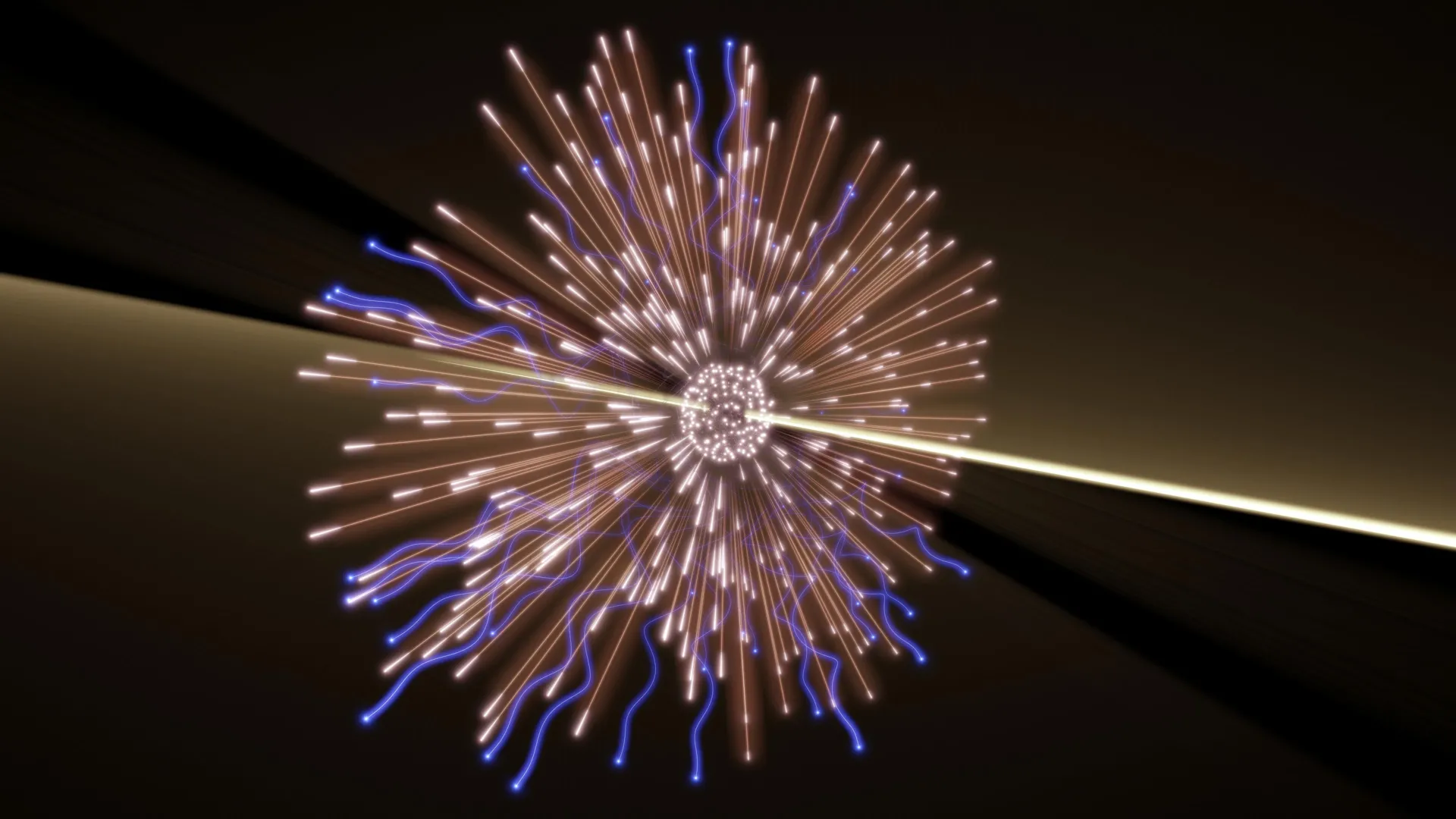

Faint antineutrino signal persists long after nuclear cores go dark—and detectors have finally seen it.
Nuclear reactors do not fall completely silent when operators flip the switch. Long-lived radioactive fragments left by fission keep decaying for months or years. They release a weak stream of antineutrinos—the lightest, most elusive particles known. These “ghost particles” slip through steel, concrete, and rock almost undisturbed.
For the first time, scientists have measured that residual glow. The Double Chooz collaboration recorded it at the Chooz nuclear power plant in northern France. The work, led by Anthony Onillon and Thierry Lasserre of the Max-Planck-Institut für Kernphysik in Heidelberg, appeared in Physical Review Letters.
How the Detection Worked
The Double Chooz detector sits underground about 400 meters from the plant’s two reactor cores. It holds more than 30 cubic meters of liquid scintillator. When an antineutrino interacts, the material produces a characteristic pair of light flashes: one from a positron and a delayed one from a captured neutron. That double signal stands out against background noise.
Researchers analyzed 17.2 days of data collected while both reactors were fully shut down. In that window the detector registered roughly 100 candidate antineutrino events—about 106 in the strongest energy range, with an uncertainty of 18. The statistical significance reached 5.9 sigma. Detailed simulations of remaining fuel and long-lived fission products had predicted about 88 events. The numbers matched closely.
“Until now, reactor antineutrino experiments have mainly focused on operating reactors, where the antineutrino flux is much larger,” Onillon noted. “Detecting the tiny residual signal after shutdown required exceptionally low backgrounds and careful analysis techniques.”
Why This Matters
Antineutrinos cannot be blocked or easily hidden. That makes them natural messengers of nuclear activity. Until now, most monitoring efforts focused on reactors while they ran. The new measurement shows detectors can also track residual fuel in cores and spent-fuel cooling pools after shutdown.
The result supplies the first published experimental benchmark for these faint emissions. Other projects, including early JUNO-TAO analyses presented at Neutrino 2026, are already examining reactor-off data for the same signal. Future systems could help verify reactor status during maintenance or independently inventory spent fuel—useful tools for nuclear safety and non-proliferation safeguards.
Double Chooz originally measured the neutrino mixing angle θ13, a key parameter in how neutrinos change identity as they travel. Catching the afterglow adds a practical new chapter to that legacy.
The reactors may go dark. Their ghostly particle trail does not.
AI Disclosure: This article was created with the assistance of artificial intelligence tools and was reviewed and edited by the Glowls News editorial team before publication.