


New AI model and phones land in rapid succession, tightening the link between software and silicon.
Google moved fast this week. On August 12 it unveiled the Pixel 11 series at its Made by Google event. One day later it released Gemini 3.7 Flash, calling the model its most capable workhorse yet for coding and agents.
The timing is no accident. Both moves push Gemini deeper into everyday hardware and developer tools.
Gemini 3.7 Flash: Faster Gains, Lower Price
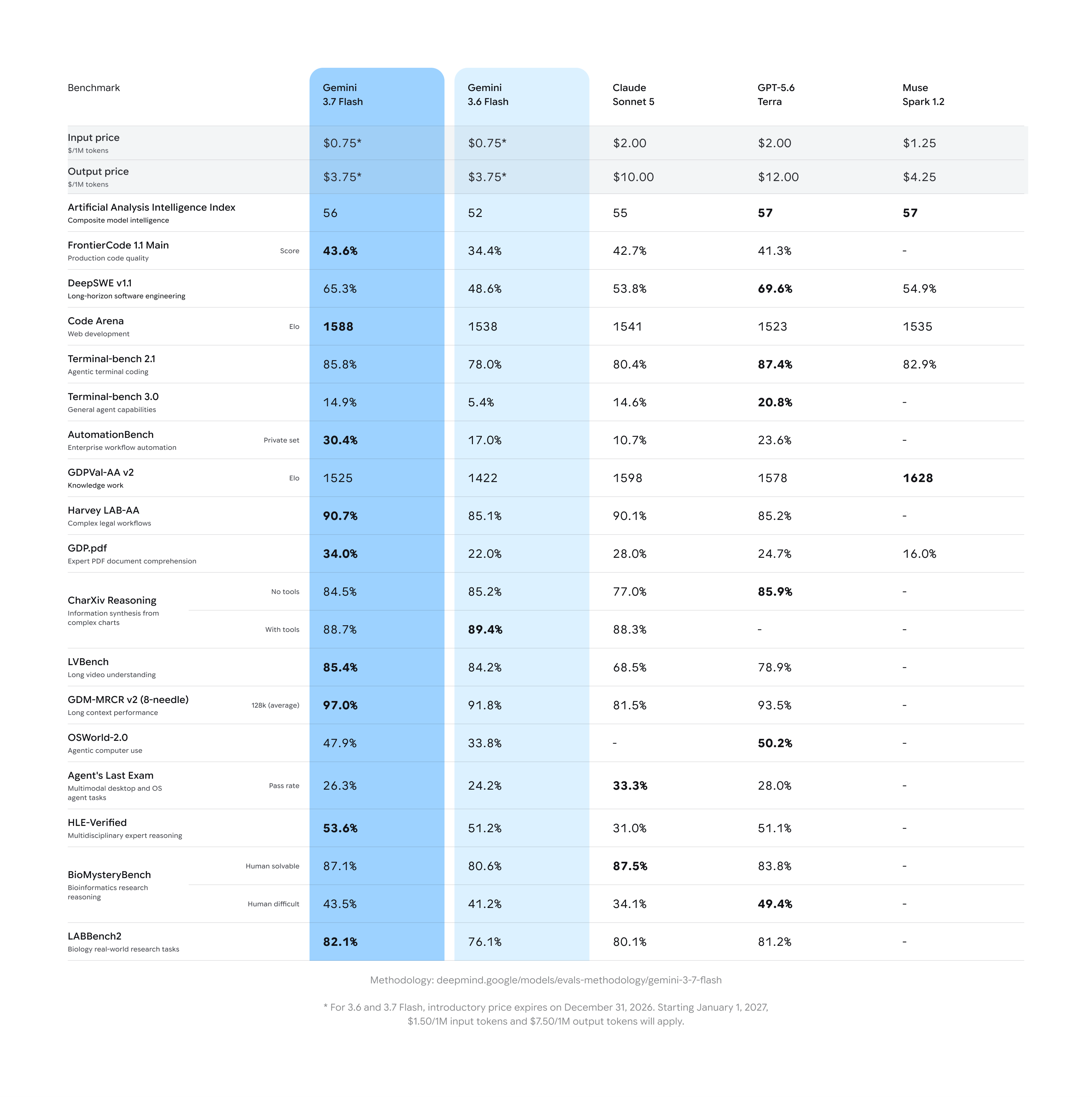
Gemini 3.7 Flash arrived just three weeks after Gemini 3.6 Flash. Google attributes the quick turnaround to developer feedback and algorithmic refinements rather than a full new training run.
Key improvements focus on real work:
- Coding benchmarks jumped. FrontierCode 1.1 Main rose from 34.4% to 43.6%. DeepSWE v1.1 climbed from roughly 49% to 65.3%.
- Web development scores improved on Arena.ai’s WebDev Arena (Elo 1588 vs 1538).
- Document-heavy tasks saw gains on the GDP.pdf benchmark (34% vs 22%).
The model keeps a 1-million-token context window and supports up to 65,536 output tokens. It handles text, images, video, audio, and PDFs. Thinking levels (low, medium, high) let developers balance quality against speed and cost.
Pricing is the other headline. Through December 31, 2026, Gemini 3.7 Flash costs $0.75 per million input tokens and $3.75 per million output tokens — half the original 3.6 Flash rate. Prices rise to $1.50 and $7.50 on January 1, 2027.
Google is already rolling the model into Gemini Spark for AI Pro and Ultra subscribers. It also powers tools in Antigravity, the Gemini API, and enterprise agent platforms.
Pixel 11 Series: Built for Gemini
The Pixel 11 lineup — Pixel 11, Pixel 11 Pro, Pixel 11 Pro XL, and Pixel 11 Pro Fold — ships with the new Tensor G6 chip. Google designed the phones around “Gemini Intelligence,” with stronger on-device AI support.
Camera upgrades stand out. The base Pixel 11 gets a larger 48-megapixel main sensor that captures 56% more light. Pro models add further sensor and zoom improvements, plus features such as Instant Night Sight and advanced video tools.
All models start with 256 GB storage (up from 128 GB last year) and promise seven years of OS, security, and Pixel Drop updates. Pricing starts at $899 for the Pixel 11, $1,099 for the Pro, and $1,299 for the Pro XL. Pre-orders opened August 12; retail availability begins August 20.
Google also introduced the Pixel Watch 5 and its first Pixel Tag tracker at the same event.
Why the Double Drop Matters
Google is treating software and hardware as one system. The rapid Flash update keeps developers inside its ecosystem with better performance and temporary lower costs. The Pixel 11 gives those same models a dedicated device with longer support and on-device power.
Early feedback from Google’s own engineers and outside users points to fewer retries and tighter multi-step execution. Whether the gains hold up against rivals such as Claude Sonnet 5 and GPT-5.6 Terra will become clearer in the coming weeks of real-world use.
For now, the message is clear: Google wants both its AI and its phones to feel faster, smarter, and harder to leave.
AI Disclosure: This article was created with the assistance of artificial intelligence tools and was reviewed and edited by the Glowls News editorial team before publication.