
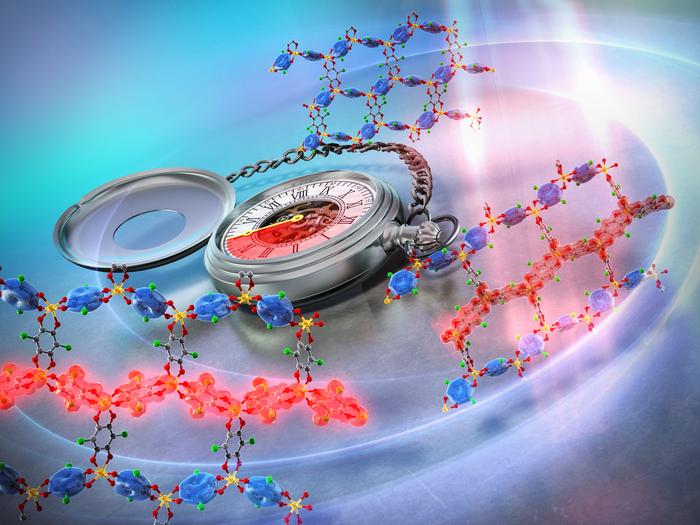

Japanese researchers catch light-driven material switch that happens faster than most cameras can imagine.
A single pulse of light can shove certain materials into strange new electronic states that never appear under normal conditions. In a metal-organic framework, scientists have now watched one of these “hidden” states form in only 30 femtoseconds. Additionally, they spotted the fleeting intermediate step that makes it possible.
The team, led by Assistant Professor Tadahiko Ishikawa at the Institute of Science Tokyo with collaborators from Tohoku University and Nagoya Institute of Technology, used ultrashort laser pulses and theory to track the process. Their results appeared in Physical Review Letters on July 22, 2026.
Watching Bonds Reorganize in Real Time
Metal-organic frameworks link metal ions with organic molecules into open, ordered structures. When this particular framework absorbed a six-femtosecond laser pulse, its reflectance spectrum changed sharply within 30 femtoseconds. New features appeared that matched a fresh optical absorption band—the signature that a photoinduced hidden state had arrived.
Theory filled in the missing sequence. Right after light absorption, the material briefly entered a bond-order wave state. Neighboring electronic bonds alternated between stronger and weaker in a repeating pattern. That short-lived electronic rearrangement was followed by tiny shifts in atomic positions. Together they produced the final hidden state.
Calculations further suggest the new state may be polar, with positive and negative charges unevenly distributed across the material. Such polarity could one day let researchers tune electronic behavior with light alone.
Why the Speed Matters
Photoinduced states already offer a way to change material properties without heating or cooling. Most earlier observations caught the later stages. However, capturing the first 30 femtoseconds reveals the actual electronic pathway. It also shows that a previously unknown intermediate state guides the transition.
Ishikawa notes that revealing these intermediate states could help design materials that respond efficiently to light. The same combination of time-resolved reflectance spectroscopy and modeling may work on other compounds. As a result, it opens a broader search for light-switchable systems.
Potential payoffs include faster optoelectronic devices and materials whose conductivity or polarity can be flipped almost instantly. The work also underscores how metal-organic frameworks serve as useful platforms for exploring nonequilibrium quantum states. These states remain hidden under everyday conditions.
The 30-femtosecond window is brief even by the standards of ultrafast science. Yet by freezing that instant, the researchers have mapped a concrete route from ordinary light absorption to a new electronic order. Consequently, they have given materials scientists a clearer target for engineering the next generation of light-controlled technologies.
AI Disclosure: This article was created with the assistance of artificial intelligence tools and was reviewed and edited by the Glowls News editorial team before publication.