
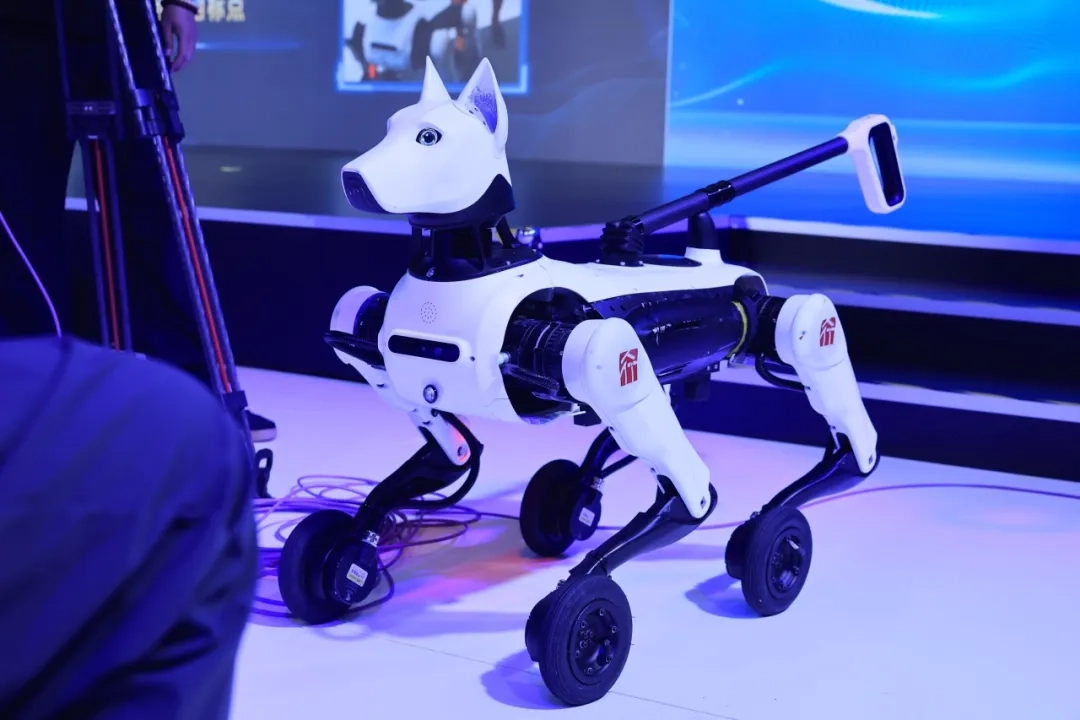

A quiet hybrid machine aims to close a 17-million-person gap in guide-dog supply.
China has more than 17 million people with visual impairments and about 400 working guide dogs. On Friday, a defence-linked lab put a machine in that gap: Xiaoyuan, a four-legged robot that rolls on wheels, then walks up stairs.
The unit debuted at the China Care and Rehabilitation Expo in Beijing. Hangzhou’s Zhiyuan Research Institute, tied to China North Industries Group, showed it under the Yuanshan Zhixing brand. Developers call it the country’s first wheeled-legged guide robot built for people who cannot see.
Wheels for quiet streets, legs for the next flight
On flat ground Xiaoyuan glides on wheels. At a staircase it switches to a four-legged gait and climbs or descends. The point of the wheels is not speed. It is silence. Users who map the world by sound cannot afford a noisy motor covering footsteps, traffic, and voices. The company says the robot runs quietly enough to leave that audio map intact.
It also watches the air above the cane line. Low branches, scaffolding, and other hanging hazards are hard for a white cane to find. Xiaoyuan is built to spot them early, slow down, and steer around them. Indoor obstacle-avoidance is listed at 99 percent or better. Outdoors the figure is at least 96 percent, with positioning error held under 30 centimeters.
More than a moving bumper
The feature list reads like a compact assistant, not a toy dog. Route navigation. Voice talk. Reminders. A panic alert that can pull in a remote volunteer. The robot plugs into disabled-persons’ federation systems and accessible maps, so a user is not walking alone in software terms either. Shape and leash feel are meant to match a real guide dog’s walking rhythm, so the body does not have to relearn how to follow.
Why this machine exists
Training a living guide dog takes years. Demand in China dwarfs supply. Earlier lab projects, including six-legged campus robots, never left the pilot stage at scale. Xiaoyuan is already in talks with several regional disability federations. Hangzhou’s Xihu district has opened roads, malls, parks, and subway stations for tests. That is the real test: not a booth demo, but a crowded platform at rush hour.
The design is also a civilian use of defence-adjacent robotics. Norinco’s research arm is selling quiet mobility and sensor fusion as care tech. That is the industry story as much as the social one. Hybrid wheel-leg machines are spreading across Chinese labs for inspection and rescue. This one is built to walk beside a person who cannot see the curb.
It will not replace a trained dog’s judgment overnight. Company figures are self-reported. Rain, crowds, and broken tactile paving will decide whether 96 percent outdoors is enough. For now, China has put a rolling, climbing stand-in on the pavement where living dogs are scarce.
AI Disclosure: This article was created with the assistance of artificial intelligence tools and was reviewed and edited by the Glowls News editorial team before publication.