
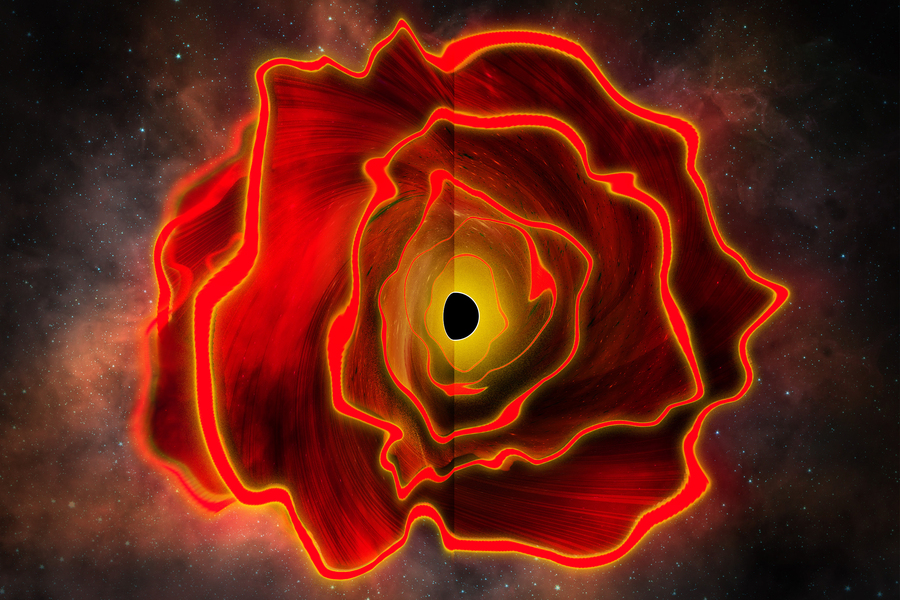

JWST reveals a solar-system-sized hybrid powered by a hidden black hole just 660 million years after the Big Bang.
Astronomers hunting the earliest galaxies with the James Webb Space Telescope found something stranger. A brilliant red point of light, invisible in bluer filters yet blazing in red ones, refused to fit any known category.
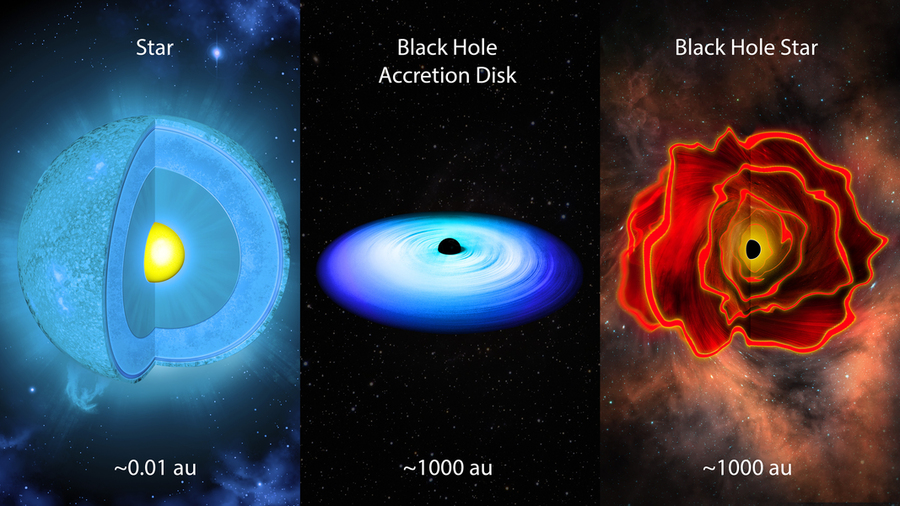
They call it MoM-BH*-1. It looks like a star the size of our entire Solar System. Yet it pours out roughly 100 billion times more energy than any ordinary star could produce through nuclear fusion. The power source matches a black hole instead.
In a paper published August 12, 2026, in Nature, a team led by Rohan Naidu of MIT and the University of Hawaii presents the first confirmed example of what they term a “black hole star.”
A Dense Cocoon of Hydrogen
The object sits at redshift 7.76, meaning its light left when the universe was only about 660 million years old. Spectroscopy showed the strongest Balmer break ever measured—a sharp drop in light at certain wavelengths caused by dense hydrogen gas. Ordinary stars cannot produce a break this extreme. The spectrum also revealed almost no metals, only hydrogen and helium. In addition, it revealed broad emission and deep absorption lines from turbulent gas.
Simulations point to a central black hole of roughly 100,000 solar masses. Around it sits an extraordinarily dense, turbulent envelope of hydrogen spanning 10 to 100 astronomical units—the scale of our Solar System. Radiation from the black hole’s accretion disk filters through this gas cocoon. Because of this, the envelope absorbs and scatters the light. This gives the object its extreme red color and star-like spectrum without needing dust.
“We think there is a central black hole that is 100,000 times as massive as the sun. And around this black hole, there would be this very extended envelope of gas that looks like a star the size of the solar system. It’s huge,” Naidu said.
Why This Matters
Little red dots have littered almost every deep JWST image of the early universe. They are compact, extremely red, and common in the first billion years, yet largely vanish later. For years their nature stayed debated—dusty galaxies, odd stars, or something else.
MoM-BH*-1 outshines its host galaxy so thoroughly that astronomers see nearly pure light from the black-hole-plus-gas system. Naidu notes that every little red dot examined so far appears consistent with a similar gas-enshrouded black hole embedded in an early galaxy. However, this object is simply the clearest, brightest case.
The find also offers a pathway for rapid black-hole growth. A black hole feeding inside such a dense cocoon could accrete near or above the Eddington limit. This helps explain how supermassive black holes reached enormous masses so soon after the Big Bang.
The team named the source MoM-BH*-1 after the Mirage or Miracle survey that found it. The “-1” signals they expect more. Furthermore, follow-up observations are already planned to test whether these hybrids formed through mergers of massive stars in dense clusters and how long the phase lasts.
What once looked like a puzzling red speck now opens a new window on the cosmic dawn—when black holes and stars may not have been so separate after all.
AI Disclosure: This article was created with the assistance of artificial intelligence tools and was reviewed and edited by the Glowls News editorial team before publication.