
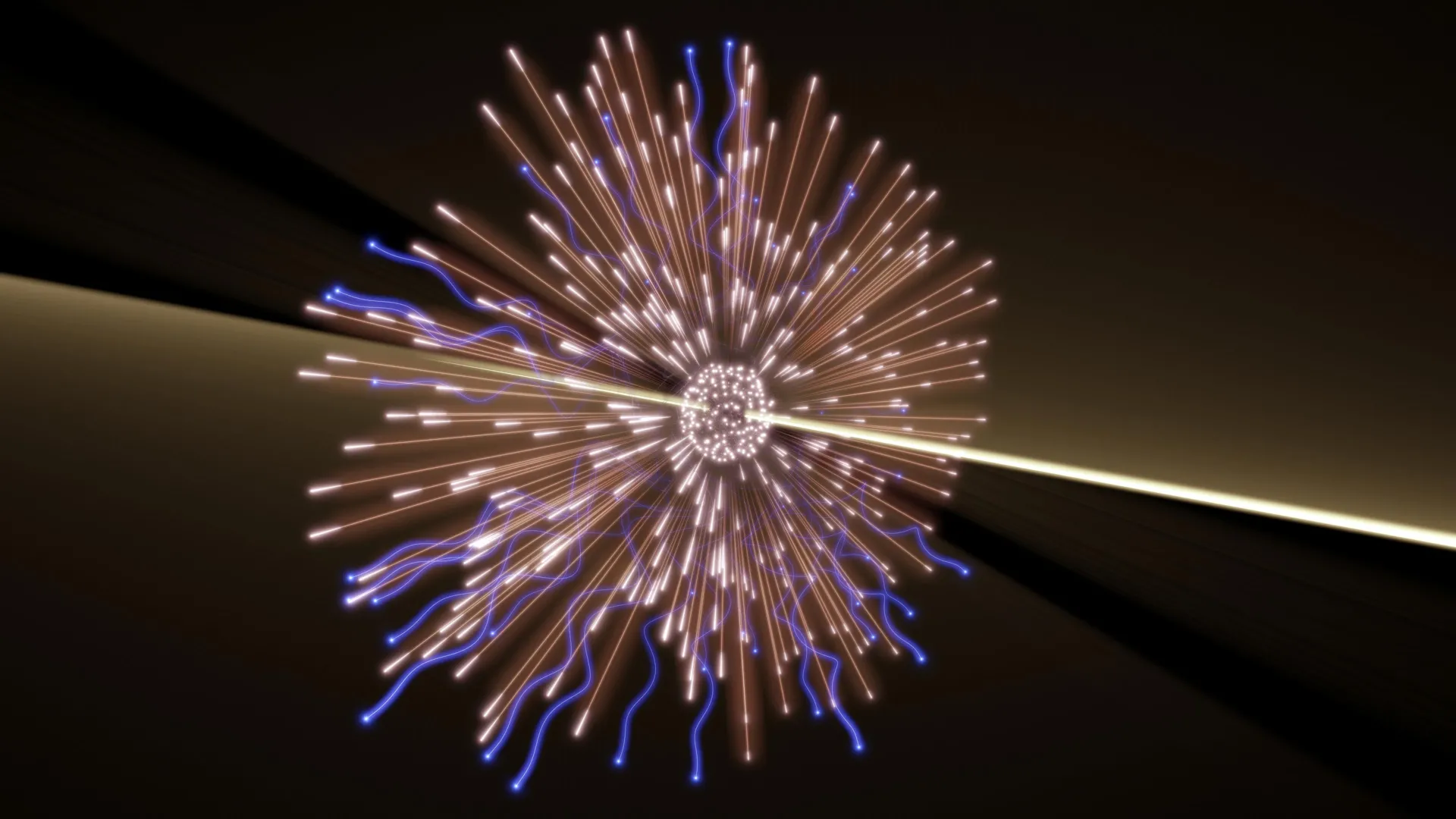

Physicists recreate the universe’s first millionth of a second by colliding oxygen and neon — and read nuclear shapes from the wreckage.
Scientists long assumed only the heaviest atomic nuclei, like lead, could recreate the blazing soup that filled the cosmos right after the Big Bang. However, that assumption just shattered.
Researchers at CERN’s Large Hadron Collider smashed oxygen-16 and neon-20 nuclei together at nearly the speed of light. The collisions produced tiny droplets of quark-gluon plasma — the primordial state of matter from the universe’s first millionth of a second. Because of this, they call it a Little Big Bang.
The work, led by Associate Professor You Zhou of the Niels Bohr Institute and published this month in Physical Review Letters, used data from a short July 2025 run at 5.36 TeV per nucleon pair. About three billion oxygen-oxygen and 400 million neon-neon events passed ALICE’s cuts.
“We have pushed the boundary for how small the atomic nuclei can be while still recreating this primordial matter,” Zhou said.
Reading Shapes From Particle Shadows
The plasma lasts only a fraction of a second before expanding and cooling into ordinary particles. Those particles carry a memory of the original nuclei.
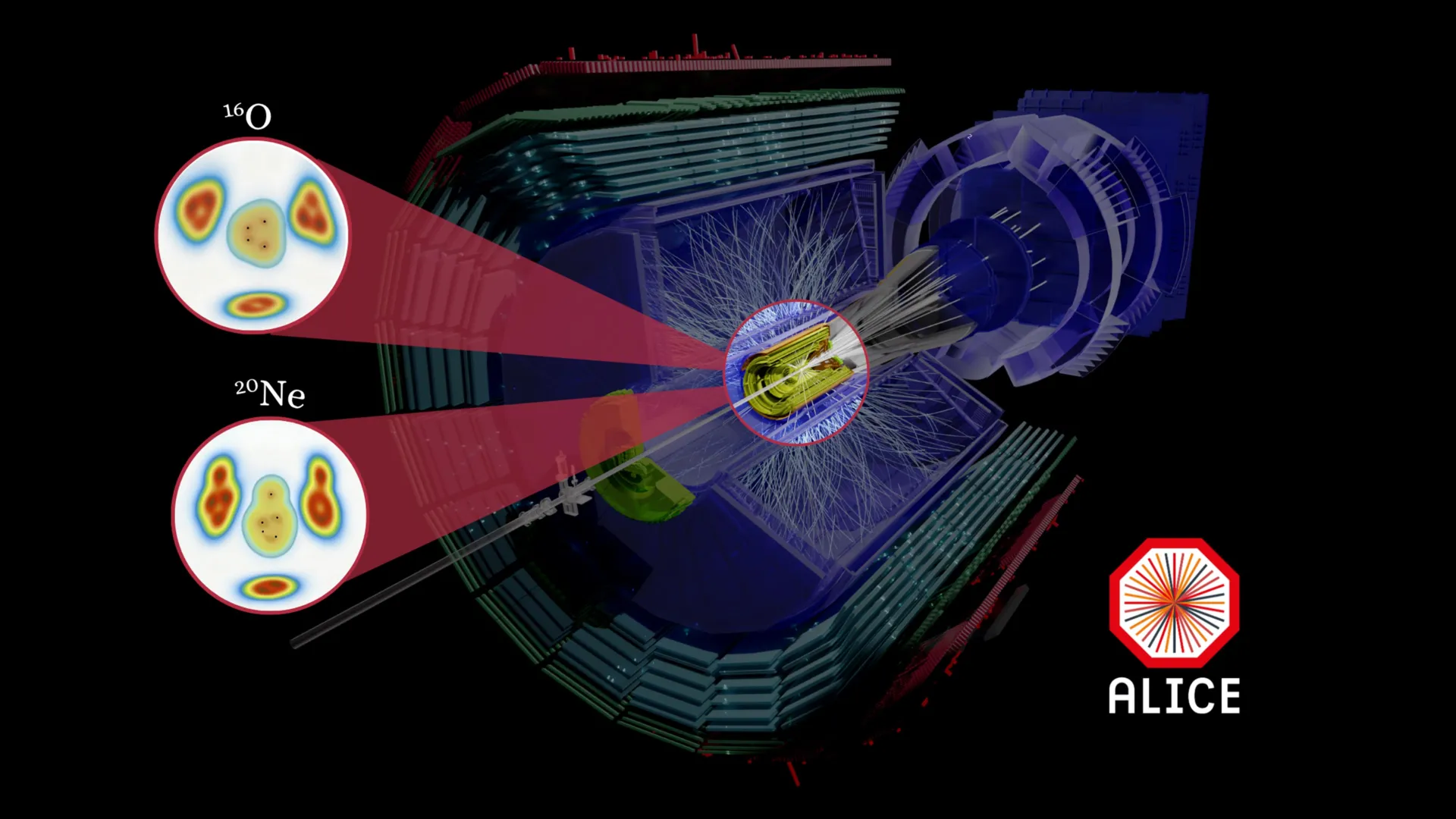
Oxygen collisions produced rounded flow patterns. Neon collisions left a bowling-pin signature. Neon-20 is predicted to have a clustered, elongated structure; oxygen-16 is more tetrahedral.
“It is a bit like shining light on an object and seeing its shadow,” said co-author Emil Gorm Dahlbæk Nielsen. “The movement of the particles reveals the geometric shape of the atomic nuclei.”
Hydrodynamic models that include those nuclear geometries match the measured elliptic and triangular flow. Furthermore, all four major LHC experiments — ALICE, ATLAS, CMS and LHCb — saw supporting signs of the plasma, including energy loss of fast particles.
Why This Matters
The result tightens the conditions needed for matter to become quark-gluon plasma. In addition, it offers a new high-energy way to map nuclear structure, a problem that has occupied physicists since Aage Bohr’s Nobel-winning work.
The LHC is now in a long shutdown for upgrades. The next tests will likely use even lighter nuclei such as helium-4 to find the true lower limit.
“These two things turn out to be much more closely connected than one might initially think,” Zhou said. The same collision that recreates the birth of the universe also photographs the inside of an atom.
AI Disclosure: This article was created with the assistance of artificial intelligence tools and was reviewed and edited by the Glowls News editorial team before publication.