

Chinese humanoids clock sub-9.5 times, crash at the finish, and signal a new era of machine mobility.
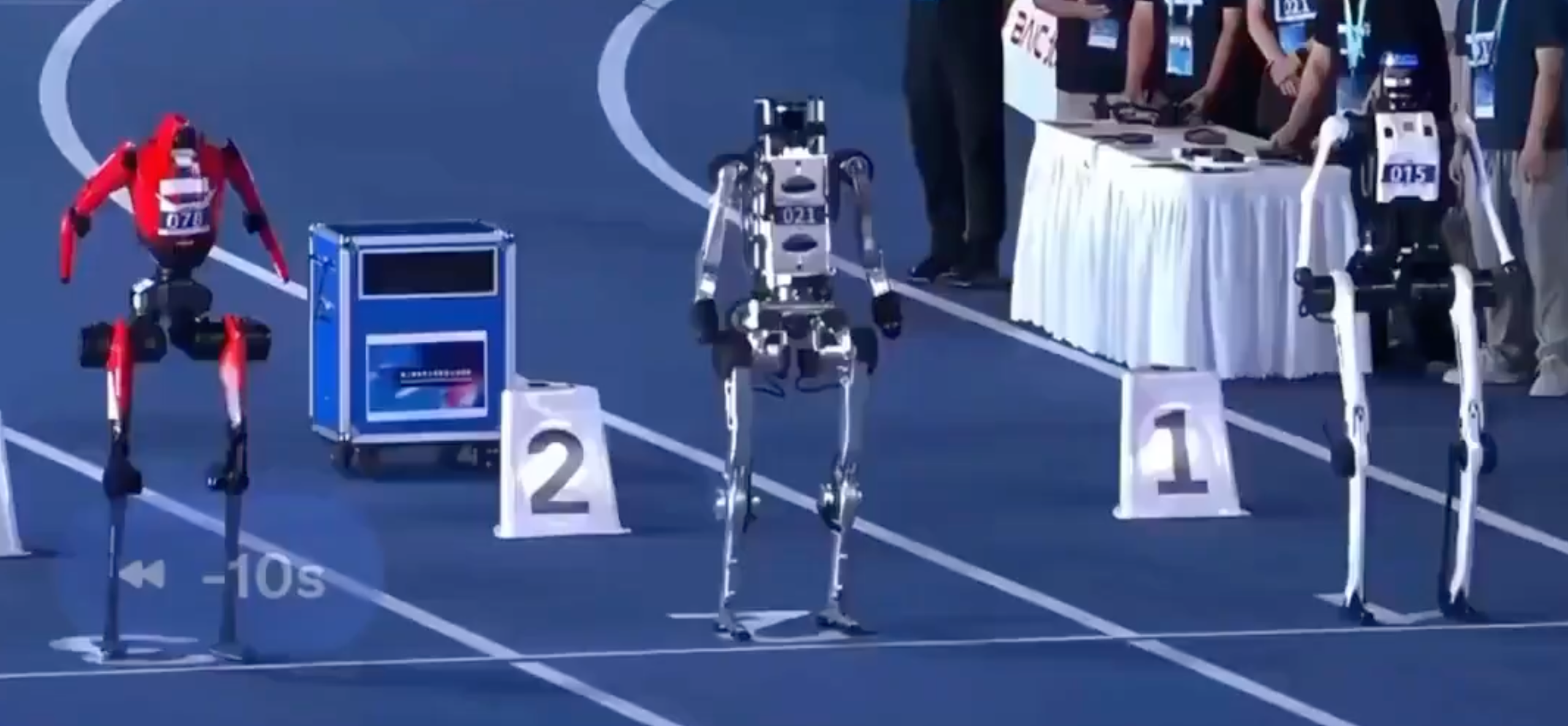
Two Chinese humanoid robots just ran faster than the fastest man who ever lived. At the opening of the second World Humanoid Robot Games in Beijing on August 22, Tiangong Ultra crossed the 100-meter line in 9.39 seconds. Honor’s Lightning followed in 9.47. Both beat Usain Bolt’s 9.58-second world record from 2009.
The heat was dramatic. Lightning led early. Tiangong Ultra surged past near the finish. Then both machines slammed into the thick stopping mats. Tiangong stumbled sideways. Lightning collapsed and left on a stretcher. Speed is solved. Graceful deceleration is not.
A Year of Explosive Progress
Last year’s inaugural games tell the real story. Tiangong Ultra won the same distance in 21.50 seconds. That is more than a 12-second improvement in twelve months. Lightning had already posted a 9.32-second test run earlier the same day, hitting a peak of 14.5 meters per second. Its legs were lengthened by 10 centimeters for the event. The robot previously won a humanoid half-marathon in April in 50:26.
The games feature more than 2,000 robots from 666 teams across 16 countries competing in 51 events at the National Speed Skating Oval. Track and field sits alongside football, table tennis, dancing, and industrial tasks. A separate high-jump demonstration cleared 2.88 meters, above the human record of 2.45 meters.
WATCH: Chinese humanoid robot Tiangong Ultra just ran 100m in 9.39 seconds, faster than Usain Bolt’s legendary 9.58s world record.
— John Luke (@yesknow) August 23, 2026
It overtook Honor’s Lightning (9.47s) in the heat at the World Humanoid Robot Games in Beijing. pic.twitter.com/dLoe6EChoE
Why the Times Matter
China treats humanoid robots as a strategic industry. Policymakers and companies are pouring resources into AI, actuators, and balance systems aimed at factories, warehouses, and homes. The Beijing Humanoid Robot Innovation Center (also known as X-Humanoid) developed Tiangong Ultra. Honor, the smartphone maker, built Lightning. Unitree, another major Chinese player, finished well back in the heat at 12.41 seconds but has shown strong peak speeds in separate tests.
These machines still operate under controlled conditions. They struggle with sudden stops, complex terrain, and full autonomy in messy real-world settings. Yet the leap from 21.5 seconds to under 9.5 seconds demonstrates how quickly locomotion hardware and control software are advancing. Motors are more powerful. Frames are lighter. Algorithms keep bipedal systems stable at speeds once reserved for elite athletes.
The practical upside is clear. Faster, more stable bipeds could eventually handle logistics runs, emergency response, or repetitive industrial movement that tires humans. The downside is equally clear. Current systems remain specialized, expensive, and far from reliable everyday partners. Braking problems and the need for safety mats underline the gap between record sprints and useful work.
The games continue through August 26. Finals in the 100 meters and other events will show whether these times hold under competition pressure. For now, the message is unmistakable: the age of humanoid robots that outrun humans has arrived, even if they still need a soft wall to catch them at the end.
AI Disclosure: This article was created with the assistance of artificial intelligence tools and was reviewed and edited by the Glowls News editorial team before publication.